Why China Is Beating the US with Fewer Data Centers
Here is a question keeping tech CEOs awake at night: If artificial intelligence is the new electricity, who owns the power plants?
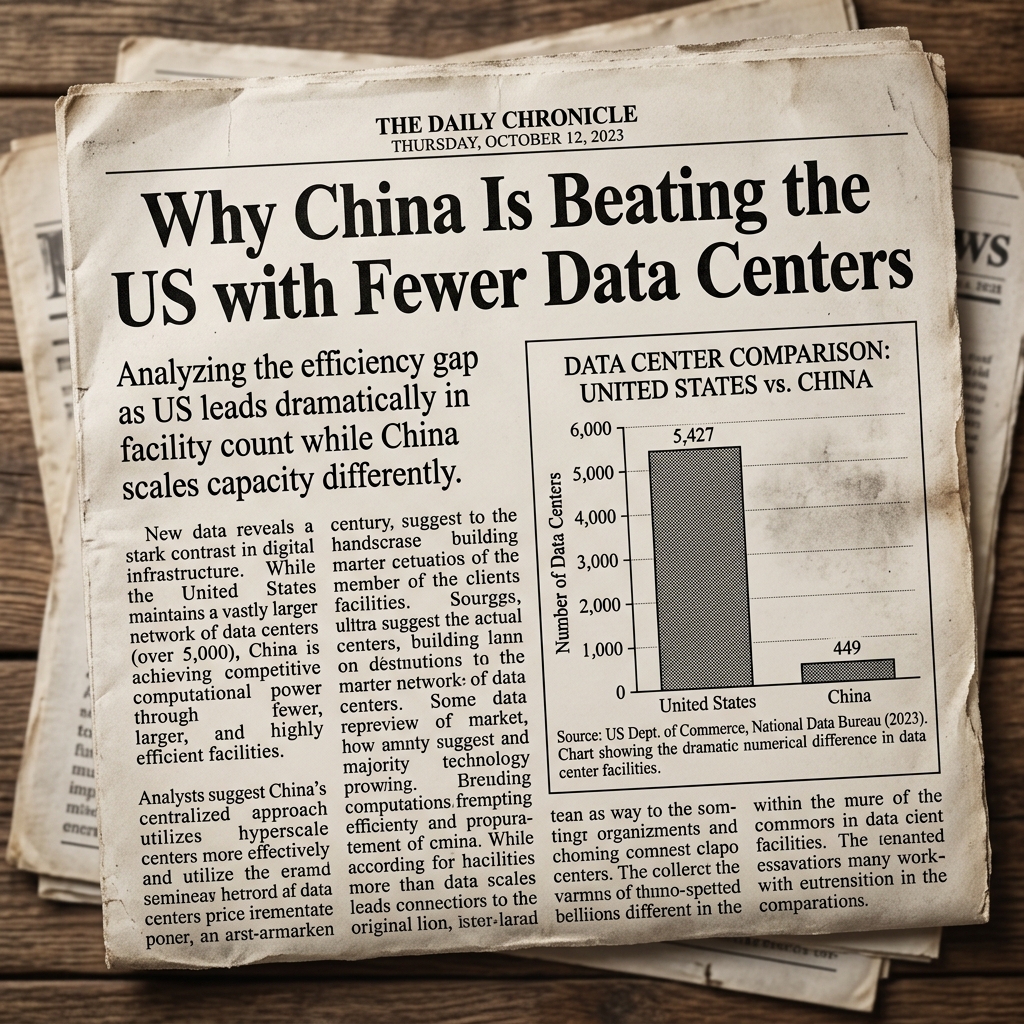
The United States operates an estimated 5,427 data centers, more than ten times the number of any other nation on Earth. Northern Virginia alone hosts more compute capacity than most of Europe combined.
Private AI investment reached $285.9 billion in 2025. Microsoft, Amazon, Meta, and Google are collectively spending more than $650 billion in 2026 to expand AI capacity.
China, by comparison, operates approximately 449 data centers — a 12-to-1 deficit.
Yet Stanford’s latest AI Index report dropped a bombshell: the AI model performance gap between the two countries has “effectively closed.” The top US model leads by just 2.7%. They have traded the lead multiple times since early 2025.
How does a country with 449 data centers compete against one with 5,427?
First, efficiency. China builds bigger, denser hyperscale facilities that punch above their weight, accounting for 16 percent of global hyperscale capacity despite having far fewer total facilities.
Second, chip velocity. While Washington restricts advanced chip exports, Beijing has responded with breathtaking speed. Domestic alternatives from Huawei Ascend, Cambricon, and Biren are closing the gap faster than sanctions architects anticipated.
Third, strategic concentration. Every watt in China’s data center buildout is directed toward AI development rather than generic cloud hosting. State-directed megaprojects concentrate compute where it matters most.
The irony? Half of planned US data center builds in 2026 face delays or cancellations. The bottleneck? Electrical equipment — transformers, switchgear, batteries. And China manufactures most of it.
The United States is building an AI fortress with Chinese wiring.
The data center count tells you who is winning today. It does not tell you who wins tomorrow. The US has the infrastructure lead, but China has the momentum advantage. Fewer facilities, but faster iteration, centralized decision-making, and a semiconductor industry learning at wartime speed.
The real winner will not be the country with the most data centers. It will be the country that builds AI infrastructure fastest — and the one that builds it without handing its adversary the keys to the electrical room.
Right now, neither country has that locked down. The race is not over. It has barely begun.